
Stripe is one of the best payments platforms ever built. It’s reliable, flexible, and developer-friendly.
But one of the most common—and costly—mistakes SaaS teams make is treating Stripe like an entitlement system.
It isn’t one. It was never designed to be.
This article explains:
- what Stripe actually does well
- why it breaks down when used for access control
- the failure modes this creates in real SaaS products
- and how to use Stripe correctly without letting it own your product logic
If you build SaaS with Stripe, this distinction matters more than you think.
What Stripe is excellent at
Stripe solves billing and payments better than almost anyone.
It answers questions like:
- Has the customer paid?
- What subscription are they on?
- What invoice state are they in?
- Was the charge successful, retried, or refunded?
Stripe is optimized for:
- financial correctness
- compliance
- reliability
- event-driven billing workflows
And this is exactly where Stripe should sit in your stack.
The trouble starts when teams expect it to do more.
The temptation: using Stripe as a source of truth for access
Many SaaS products start with logic like this:
if (stripeSubscription.status === "active") {
  allowAccess()
}
Or:
if (priceId === PRO_PRICE_ID) {
  enableProFeatures()
}
At first, this seems reasonable.
- Stripe knows if someone paid
- Stripe knows which price they’re on
- So Stripe must know what they can access… right?
Not quite.
Why Stripe is fundamentally not an entitlement system
Stripe lacks several properties that a true entitlement system requires.
1. Stripe models payments — not permissions
Stripe’s core abstractions are:
- customers
- subscriptions
- prices
- invoices
- payment intents
None of these represent:
- feature access
- usage limits
- quotas
- exceptions
- overrides
You can infer access from Stripe data, but inference is fragile by nature.
Entitlements need to be explicit.
2. Stripe state is not real-time authoritative
Stripe communicates changes via webhooks.
That means:
- events arrive asynchronously
- delivery can be delayed
- events can arrive out of order
- retries can happen hours later
If your product checks Stripe directly at request time, you risk:
- race conditions
- inconsistent behavior
- access flapping during billing transitions
Stripe tells you that something happened — not what access should be right now.
3. Stripe doesn’t understand grace periods and business intent
Consider common SaaS rules:
- “Allow access during payment retries”
- “Keep access active for 7 days after cancellation”
- “Enterprise customers keep access even if invoicing is manual”
- “Don’t revoke access during a downgrade until the period ends”
Stripe exposes raw billing state.
It does not encode your business rules.
When you tie access directly to billing state, these nuances get lost — and customers feel it.
4. Stripe can’t represent exceptions cleanly
Real SaaS businesses run on exceptions.
- Sales grants extra features
- Support fixes a mistake
- Legacy customers keep old limits
- Founders manually override access
Stripe has no native place to store:
- per-account feature overrides
- temporary grants
- historical entitlement decisions
Teams end up hacking this into metadata fields, which quickly becomes unmanageable.
The predictable failure modes
When Stripe is used as an entitlement system, teams consistently run into the same problems.
Accidental access loss
Customers lose access due to:
- failed payments under retry
- webhook delays
- partial subscription updates
Feature leakage
Customers retain access when:
- upgrades/downgrades race
- price mappings drift
- metadata isn’t updated correctly
Pricing fear
Every pricing change risks breaking production behavior.
Engineering slows down because billing changes feel dangerous.
The correct role of Stripe in a SaaS architecture
Stripe should be treated as an input, not the authority.
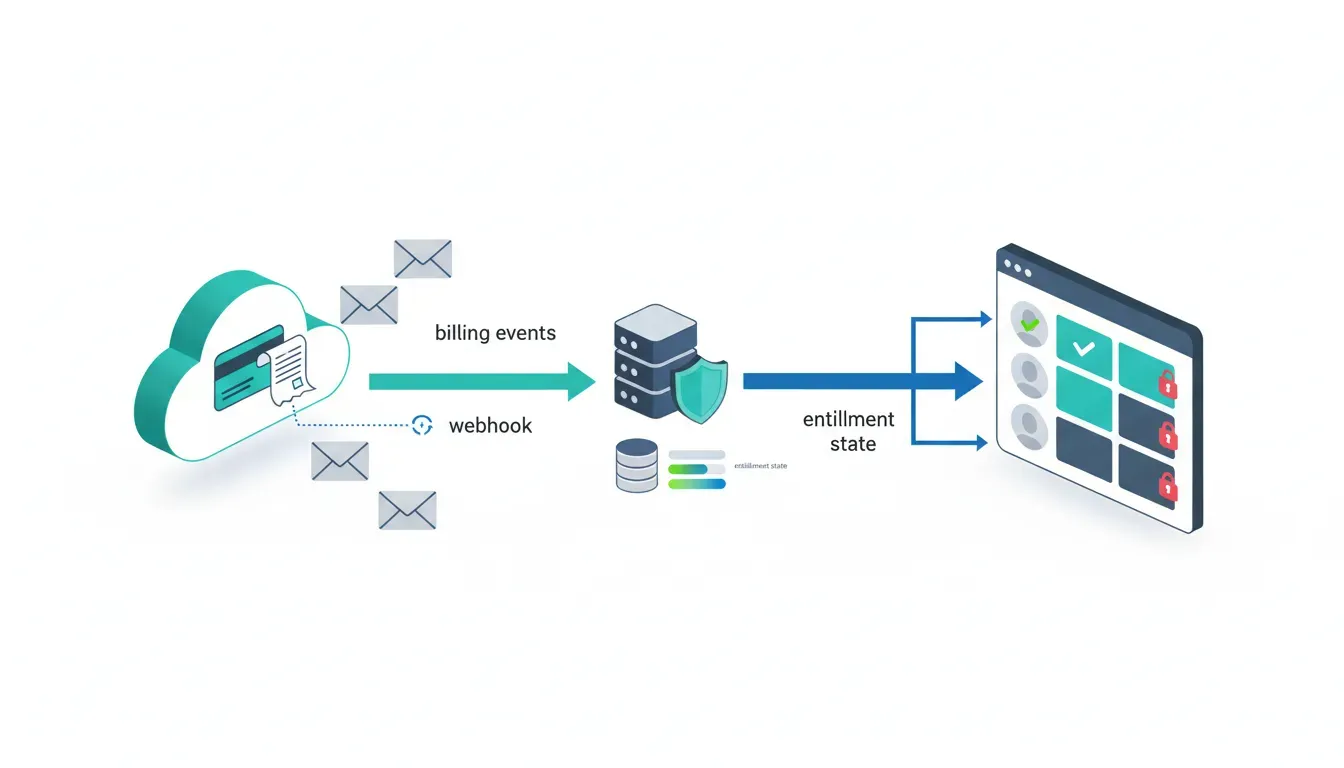
A healthy architecture looks like this:
- Stripe processes billing events
- Webhooks notify your system of changes
- Your system updates stored entitlement state
- Your application enforces access based on entitlements
Stripe informs your product — it does not control it.
What should live outside of Stripe
These things should not be inferred on the fly from Stripe:
- feature access
- usage limits
- seat counts
- trial status
- grace periods
- sales exceptions
- legacy plan behavior
All of these belong in a dedicated entitlement layer that your app controls.
What Stripe should still be responsible for
This distinction doesn’t reduce Stripe’s importance — it clarifies it.
Stripe should:
- collect payments
- track financial status
- manage invoices
- emit reliable billing events
Your system should:
- decide what customers are entitled to
- persist that decision explicitly
- enforce it consistently
Each layer does one job extremely well.
The mental model that fixes everything
Instead of asking:
“What does Stripe say about this customer?”
Ask:
“What is this customer entitled to right now — and why?”
Stripe becomes just one of several signals that influence that answer.
Final takeaway
Stripe is a billing platform.
It is not:
- an access control system
- a pricing engine
- an entitlement authority
Using Stripe correctly means respecting its boundaries.
When you separate billing from entitlements:
- pricing becomes safer to change
- access logic becomes predictable
- customers experience fewer surprises
- your system scales with confidence
Stripe stays great at what it does best — and your product becomes better because of it.