
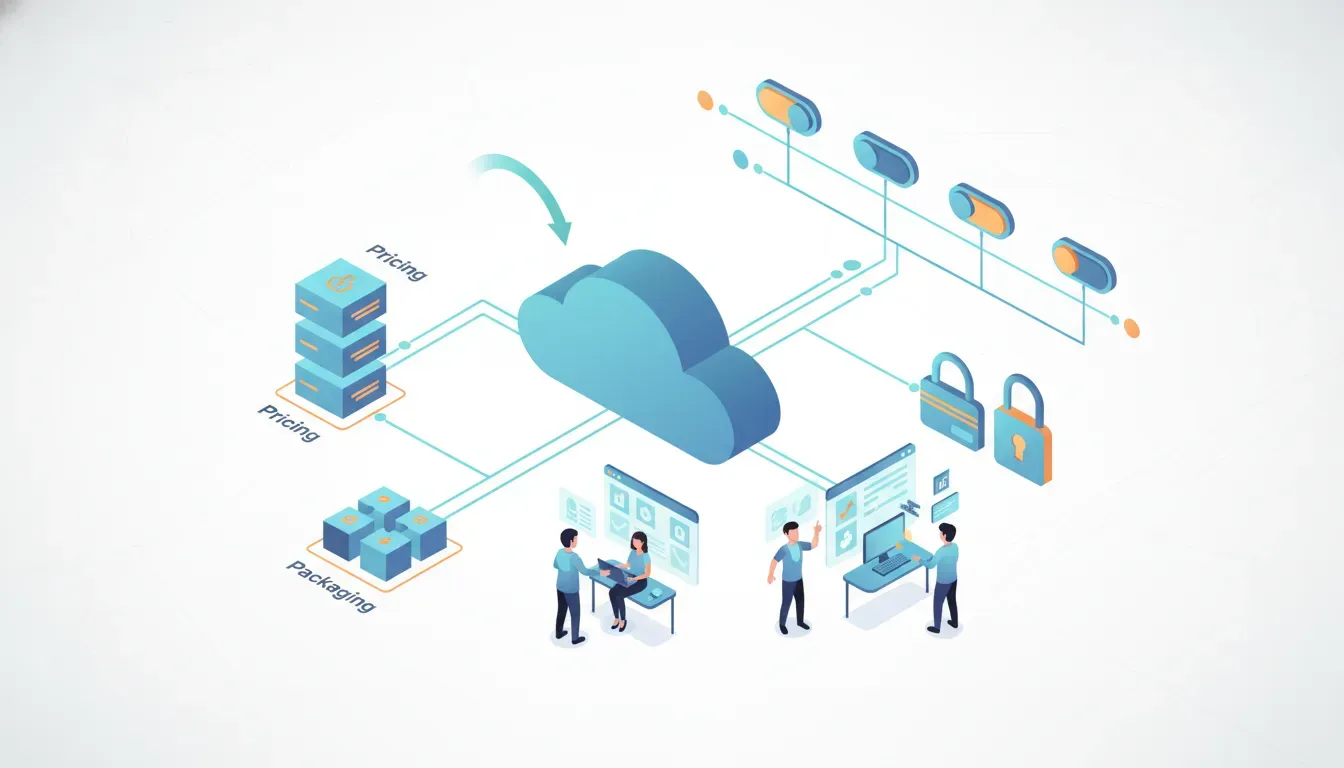
Monetizing a SaaS product is more than choosing a price. Growth-stage companies face technical and organizational decisions that determine whether monetization is a one-off scramble or a repeatable, low-friction motion. This guide explains the practical architecture, data flows, and organizational choices that let product, engineering, and revenue teams ship pricing changes, entitlements, and bundles safely and quickly.
Who this is for
This article is aimed at product leaders, engineering managers, CTOs, and growth-stage founders who need a concrete plan to turn product capabilities into revenue without creating long-term technical debt.
Why a deliberate monetization architecture matters
- Reduces friction for customers when buying and upgrading.
- Speeds commercial experiments because pricing, entitlements, and usage are observable and changeable without full releases.
- Protects engineering velocity by avoiding ad-hoc feature flags and one-off code paths that become impossible to maintain.
- Improves revenue ops by making billing and CRM consistent with what customers actually use.
Core components of a modern SaaS monetization stack
Treat monetization as a system. The architecture below lists components that should exist, even at a minimal level, by the time you move past early traction.
1. Product catalog (single source of truth)
The product catalog is a unified policy that describes products, plans, modules, features, pricing units, and bundles. It must be authoritative and accessible to product, sales, billing, and engineering.
2. Tenant model and boundaries
Define what a tenant is for your system: company, account, project, or workspace. That definition affects data isolation, how entitlements are scoped, and how customers are billed.
3. Entitlements and capabilities
Entitlements answer "what can this user or tenant do?" They should be modeled as policies or capabilities (not hardcoded role checks). Entitlements are used for both security/authorization and commercial gating.
4. Feature management (feature flags + product controls)
Feature flags are great for rollout and A/B testing. Feature management extends flags to include entitlements, metering and commercial rules. Avoid using raw, hardcoded flags as the canonical representation of who can pay for what.
5. Metering and usage collection
Metering tracks consumption (API calls, seats, storage, transactions). Even seat-based businesses need metering to support usage limits, overage billing, and fair upgrades.
6. Billing, subscriptions, and transactions
Whether you use a billing provider or a custom system, billing must reference the same product catalog and entitlements as product and CRM. Subscriptions are the contract between your business and the customer and must map to entitlements.
7. Data integration and analytics
Integrate CRM (Salesforce or equivalent), product analytics, and billing data into a single pipeline so you can correlate usage, features used, and revenue. This is essential for pricing experiments and renewals.
8. Admin/UIs and audit logs
Provide internal UIs for sales and success to change entitlements, apply credits, and configure bundle exceptions. All changes should be logged and auditable for finance and legal.
Framework to select pricing and packaging
Use a structured decision process when designing pricing and packaging to avoid repeated refactors.
- Define the job to be done (JTBD): What outcome does the customer pay for?
- Segment buyers by value: Who gets the most value from which features? Map personas to plans.
- Choose a boundary: product vs module vs platform: Commit to whether capabilities are modules of one product, separate products, or platform offerings.
- Pick pricing primitives: seats, usage units, percentage of transaction, tiered packages, or combinations.
- Design entitlements from the start: Map each plan to capabilities and limits.
- Instrument metering and analytics: Make the behavior measurable before large-scale rollout.
- Experiment, measure, iterate: Use short-term experiments but keep the long-term catalog coherent.
Practical implementation: entitlements, feature checks and APIs
Operationalize entitlements as an authoritative policy accessed by runtime checks instead of inlined feature flags. This keeps engineering simple and moves commercial control out of deploy cycles.
Basic entitlement policy example (JSON)
{
  "products": {
    "project-controls": {
      "plans": {
        "starter": {
          "price_monthly": 500,
          "capabilities": {
            "create_project": true,
            "change_orders_per_month": 5,
            "api_rate_limit": 1000
          }
        },
        "enterprise": {
          "price_monthly": 5000,
          "capabilities": {
            "create_project": true,
            "change_orders_per_month": 1000,
            "api_rate_limit": 100000,
            "advanced_audit": true
          }
        }
      }
    }
  }
}
Runtime entitlement check pattern
Implement a thin, low-latency entitlement service that the application queries at runtime or caches per session. Example flow:
- Client requests an action.
- App calls Entitlement Service with tenant and user context.
- Entitlement Service resolves policy from catalog, applies overrides (sales exceptions), and returns capability + limit + meter reference.
- App permits or blocks action and emits a metering event.
Why not just use feature flags in code?
- Feature flags are excellent for rollout, not for canonical commercial state.
- Flags can proliferate into hundreds of ad-hoc toggles that are hard to reason about.
- Feature flags alone rarely capture pricing rules, metering, or audit trails needed by finance.
- A hybrid approach works: use flags for deployment rollout and a catalog/entitlement system for long-term control.
Design decisions and trade-offs
Two common trade-offs determine your approach:
Speed versus correctness
Early stage: quick hacks to win customers are reasonable. As you scale, those hacks become crippling. Decide early which parts of monetization need long-term correctness (product catalog, subscriptions, metering) and invest accordingly.
Homegrown vs third-party vendors
Vendors like LaunchDarkly accelerate feature management, billing platforms accelerate subscriptions, and billing vendors reduce compliance burden. But vendor dependencies can introduce availability risk and often require integration work. If a vendor outage can take your product down, prefer a resilient hybrid approach or fallback paths.
Migrating from ad-hoc flags and hardcoded roles
If your product has grown with homegrown flags, adopt an incremental remediation plan:
- Inventory all flags, their owners, and usage.
- Classify by purpose: rollout-only, experiment, or commercial gate.
- Extract commercial gates into the product catalog one-by-one and implement entitlement checks.
- Deprecate obsolete flags and keep feature flags only for rollout/experiments.
- Automate reporting: Show which features map to which billing items and renewal conversations.
Data pipeline checklist for pricing and packaging
- CRM integration: Ensure every subscription maps to a tenant record in CRM.
- Product analytics: Correlate feature usage to tenant and plan.
- Billing events: Store transactions, invoices, renewals, and credits in a unified schema.
- Audit logs: Capture entitlement changes with actor, timestamp, and reason.
- Reporting: Build dashboards for usage-to-revenue, feature adoption, and churn analysis.
Common pitfalls and how to avoid them
- No single product catalog: Avoid separate catalogs in CRM, billing, and code. Create one source of truth.
- Hardcoded roles: Replace rigid role checks with capability-based entitlements.
- Lack of metering: Instrument usage early—even for seat-based models—to enable overage and fair pricing.
- Feature-flag sprawl: Regularly prune flags and separate rollout flags from commercial flags.
- Late data integration: Build the analytics pipeline early to see the effects of packaging decisions.
- Vendor single points of failure: Plan fallback strategies and avoid critical runtime dependencies on a single external service.
Practical checklist for product and engineering leaders
- Decide product boundaries (module vs product vs platform) and document them.
- Create a unified product catalog and expose it via an API.
- Model entitlements as capabilities with clear scoping to tenant or user.
- Implement a low-latency entitlement service and cache results intelligently.
- Instrument metering for all billable units and surface usage in CRM and dashboards.
- Separate feature flags for deployment from the canonical entitlement source.
- Provide an admin console with audit logs for sales, success, and finance.
- Build a data pipeline linking CRM, product analytics, and billing data.
When to invest in full monetization infrastructure
Consider investing in a consolidated platform when you notice one or more of these signals:
- Multiple ad-hoc pricing exceptions by sales are common.
- Engineering spends more time on special-case code for customers than on product features.
- Finance cannot reconcile usage to invoices easily.
- Renewals or expansion discussions lack data on feature adoption and value.
- Plans, entitlements and features are defined differently across CRM, billing, and product.
Key takeaways
- Monetization is systemic: treat product catalog, entitlements, metering, billing, and data as parts of one system.
- Decide early and commit: pick product boundaries and a canonical model for entitlements before scale makes changes painful.
- Use flags responsibly: feature flags are for rollout; entitlements are for commercial and security control.
- Build the data layer early: visibility across CRM, product usage, and billing enables rapid pricing experiments and smarter renewals.
- Plan incremental migration: move from hacky flags to a cataloged entitlement model one piece at a time to avoid outages.
Further reading and next steps
Start by creating a one-page product catalog and mapping it to current billing items. Run a 30-day inventory of flags and usage metrics. Use that output to prioritize entitlements and metering work that unlocks the highest commercial impact.