
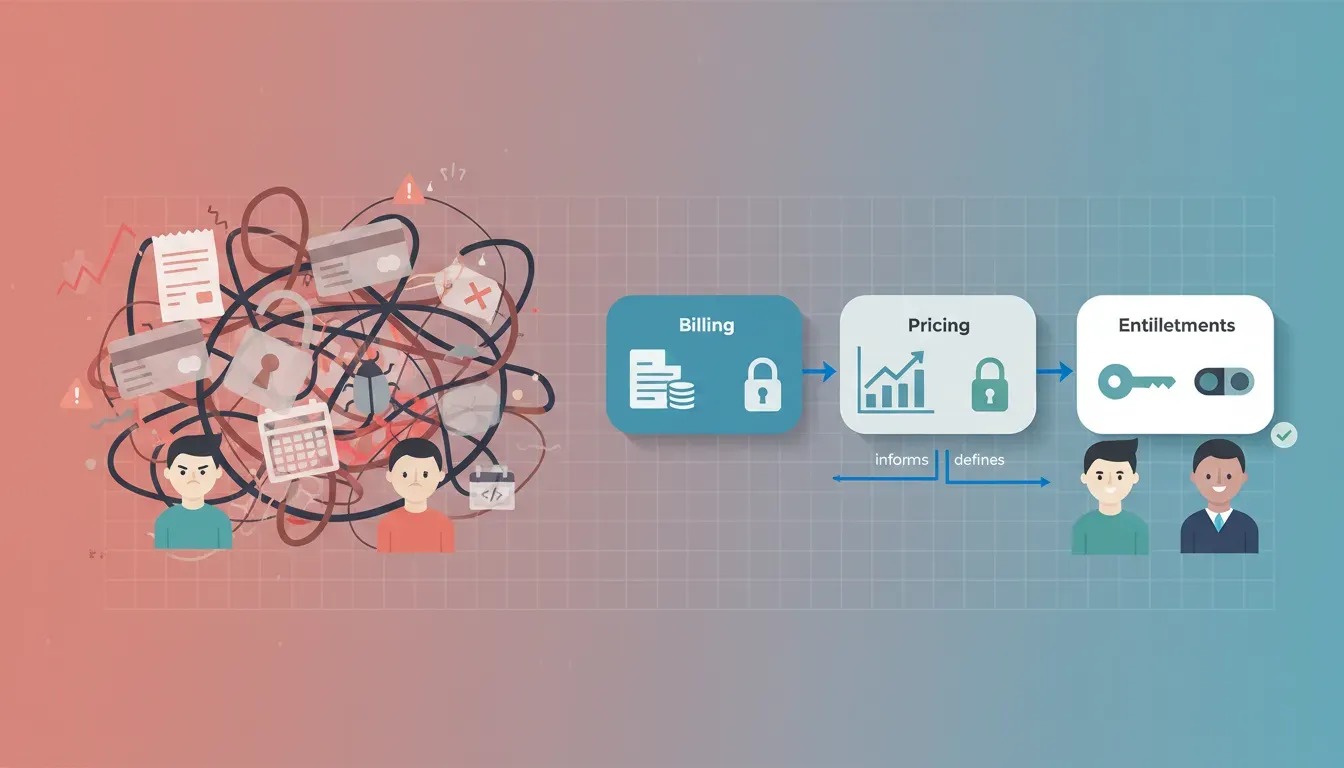
If you’ve ever shipped a pricing change that accidentally unlocked features for the wrong customers—or revoked access from paying users—you’ve likely run into one of the most common (and expensive) SaaS mistakes:
billing, pricing, and entitlements are treated as the same thing.
Early on, this confusion feels harmless. You have one plan, one subscription, and a couple of features. But as a product grows, this shortcut quietly becomes a source of:
- recurring production bugs
- brittle access control logic
- fear around pricing changes
- expensive refactors later on
This article is a practical, opinionated breakdown of:
- what billing, pricing, and entitlements actually mean
- why teams almost always conflate them
- how this shows up as real-world failures
- and how mature SaaS systems separate these concerns cleanly
If you build or operate SaaS software, understanding this distinction will save you time, money, and stress.
The three concepts—clearly defined (and why the distinction matters)
Most confusion starts with fuzzy definitions. Let’s make them precise.
Billing: who pays, how much, and when
Billing answers financial questions. Nothing more.
- Who is the customer?
- What are they charged?
- When are they charged?
- Did the payment succeed, fail, or retry?
Billing systems track things like:
- subscriptions
- invoices
- payments
- refunds
- proration
- payment state
They are optimized for financial correctness, compliance, and reliability.
Crucially, billing systems are not designed to understand:
- product features
- usage limits
- trials and grace logic
- custom customer exceptions
Billing is about money flow, not product access.
Pricing: how you package and communicate value
Pricing answers business questions.
- What plans do you offer?
- What features are included at each tier?
- How do upgrades and downgrades work?
- What does marketing promise customers?
Pricing lives in:
- your pricing page
- product and growth strategy
- internal docs and sales decks
- plan and tier definitions
Pricing defines intent and value, not enforcement.
A pricing page can say “Unlimited projects,” but nothing about that statement actually grants access inside your application.
In other words:
Pricing describes what should be possible — it does not decide what is possible.
Entitlements: what the customer can actually do
Entitlements answer runtime questions inside your product.
- Can this account access this feature right now?
- How much of a resource is this customer allowed to use?
- Has access been granted, revoked, paused, or overridden?
- Do special cases apply?
Entitlements are:
- evaluated inside your application
- enforced at request time
- independent of payment mechanics
This is the layer that ultimately decides whether an API call succeeds, a button is enabled, or a limit is enforced.
Unlike pricing, entitlements are executable truth.
Why SaaS teams naturally mix these together
Almost every SaaS product starts with a single mental shortcut:
Plan = payment = access
Early on, that assumption often holds.
- One plan
- Few features
- No sales deals
- No legacy customers
So access checks look simple:
if (subscription.plan === "pro") {
  enableFeatureX()
}
This works — until reality shows up.
The moment this mental model breaks
The “plan equals access” model fails as soon as you introduce any real-world complexity:
- free trials with delayed billing
- grace periods on failed payments
- grandfathered customers
- usage-based pricing
- enterprise or custom plans
- temporary promotions
- manual overrides from support or sales
At this point, billing data is no longer a reliable representation of what the customer should be allowed to do.
Teams respond by adding conditionals:
- scattered feature flags
- ad-hoc database fields
- hardcoded plan checks
- manual exceptions
Access logic slowly sprawls across the codebase.
The most dangerous failure mode: coupling access to billing state
The single biggest architectural mistake is treating billing systems as the source of truth for access control.
This shows up when:
- a failed payment immediately cuts off access
- a retrying invoice blocks core features
- upgrades and downgrades cause race conditions
- webhook delays create inconsistent state
Billing systems emit events — they do not guarantee real-time correctness.
When access depends directly on billing state, your product becomes vulnerable to:
- timing issues
- partial failures
- inconsistent customer experiences
Customers feel this as “the product is unreliable.”
Engineering feels this as “pricing changes are scary.”
Real-world consequences of mixing billing, pricing, and entitlements
When these layers are not separated, teams consistently see the same problems.
1. Accidental feature leakage
Users gain access they never paid for due to mismatched state or missed revocations.
2. Over-revocation and churn
Paying customers lose access because payments are retrying, invoices are pending, or webhooks lag.
3. Inconsistent plan behavior
Marketing promises one thing. Sales promises another. The product enforces something else entirely.
4. Pricing paralysis
Teams avoid experimenting with pricing because any change risks breaking production behavior.
5. Unscalable exception handling
Every edge case becomes a one-off patch that no one feels safe touching later.
These issues compound quietly — until they dominate engineering time.
How mature SaaS systems separate these concerns
High-performing SaaS organizations treat billing, pricing, and entitlements as distinct layers with clear responsibilities.
Billing
- Tracks subscriptions, invoices, and payment state
- Focused on financial accuracy
- Emits events when state changes
Pricing
- Defines plans, features, limits, and packaging
- Evolves independently from payment tooling
- Can change without breaking runtime logic
Entitlements
- Lives inside the product domain
- Stores the authoritative access state
- Evaluates permissions and limits at runtime
In this model:
- billing informs entitlements
- pricing defines entitlements
- entitlements enforce access
No layer oversteps its role.
The mental shift that unlocks scale
Immature systems ask:
“What plan is the customer on?”
Mature systems ask:
“What is this account entitled to right now?”
That entitlement state may be influenced by:
- an active subscription
- a trial window
- manual grants
- legacy pricing
- sales exceptions
Billing becomes an input — not the authority.
Why this matters earlier than you think
Teams often assume this separation is only necessary at enterprise scale.
In practice, it becomes painful much sooner — often right when:
- revenue starts to matter
- customer support scales
- pricing experiments accelerate
Implementing clean separation early:
- reduces future refactors
- makes pricing safer to change
- improves customer trust
- keeps access logic understandable
Final takeaway
Billing, pricing, and entitlements are related — but they are not interchangeable.
- Billing answers who paid
- Pricing answers what you sell
- Entitlements answer what customers can actually do
SaaS products that separate these layers:
- move faster
- break less often
- and evolve pricing without fear
Those that don’t eventually pay the cost — usually at the worst possible time.